
Last Wednesday the excellent race promoters behind Into The Wild OC Trail Runs hosted the FIRST competitive event—since 1984!—at a special place in the hills just east of my hometown of Orange, CA.
Across this internationally (yes indeedy!) iconic race venue, Into The Wild laid out a super-fun course: 3.6 miles of looping, rolling trails following the contours of the hills where (from 1967 to 1984) “The world of motocross and off-road racing revolved around this parcel of land”—Saddleback Motocross Park, aka “America’s Legendary Motor Playground.”

(Along with Tim Marks’ web site, more Saddleback lore can be found here where the always-entertaining Jody Weisel weaves a tale of historic proportions with plenty of amazing “back in the day” Saddleback MX photos.)

Though I came to motocross racing late in life (in my early 20s, as a young mom with three kids), I was fortunate enough to have raced at Saddleback in October 1983—the Women’s Motocross Nationals— shortly before it closed forever (after 1984’s AMA Nationals).

From the program page “Moms Who Race”:

Forty-some years later, the land is once again open to the public (designated events only) as part of the OC Parks Irvine Ranch Open Space.
SO . . . HOW SUPER EXCITED was I when I found out some of my favorite race directors (Alison Wenster and Michael Hooker, Mike himself being a former pro motocrosser) were putting on one of their wonderful Into The Wild OC races there May 1?!
In keeping with their all-around amazingness, they even agreed to transfer my entry fee from an ITW-OC race I was unable to run last December due to a long-lingering ghostly knee pain. Yep. It’s taken all of five months to recover from a very weird top-o’-my-tibia burning sensation.
But—thanks to trainer Leo at SCAR in Orange, Feldenkrais/movement coach Darcia, and Jae Grunke’s Feldenkrais-based Balanced Runner Online Camp, I lined up at the starting line last week feeling ready to have some running fun.
Did I miss the intoxicating perfume & music of two-stroke engines? (Yikes–I guess I did, a little bit.)
But I was glad not to have to worry about mechanical problems this time around. (Seems like I had a last-minute fuel line panic last time I lined up to race at Saddleback. But that was 40 years ago. Maybe it was the spark plug gone south at the Viewfinder’s GP that year? Ah, motor memories . . . )
Anyway, this time it was just me and my bare feet loping through lengthening shadows in the middle of an aromatic regrowth of all my favorite California native plants: sage and buckwheat and laurel sumac and on and on. Bird calls instead of the brrp brrrrrp of shifting gears. Rattlesnake howdys more likely than me overshooting a turn and crashing.

Was this bliss? Memories of what was, mixed with enjoyment of what is, and me just counting and coordinating my breath/footfall rhythm and trying to pass . . .
One. More. Runner.
Because I remain as unrealistically competitive in my gray decades as I was during my muscle-y twenties, way back when it felt like a victory every time I didn’t pass the checkered flag DFL. (That was a thing back then, we just didn’t have the acronym yet . . . )

Past, present, and . . . future hopes to run this dirt again at the next Saddleback Wilderness race in June!
I got my PR last week (ummm . . . actually everyone did as it was the first race there ever)—so now I’m wondering: can I beat it next time out? Am I still getting faster? (See previous comment about unrealistic competitivism.)
To counteract that frantic energy: ITW-OC’s race permit only allows for 75 participants, which does much to create a peaceful, friendly vibe.
AND let’s not forget the icing on the race cake:

Getting to say “hello” to one of my motocross heroes, the legendary Jeff Ward, whose daughter Siena ran to the third place female finish.

Speaking of finishing: while I did not make the podium at the Women’s Motocross Nationals at Saddleback in 1983, I did finish second in my age group (60-69) last week, and 18 (out of 36) female overall.

For this, my 14th year of barefoot trail running (and occasional racing), I am very grateful. Also on my gratitude radar: Medicare health insurance starts in three weeks. Yup. I’m at the end of my “Paul McCartney” year.
(Just a bit more braggage: my trip down motocross memory lane this morning unearthed some old Women’s Motocross Nationals programs/results—and in 1985 I did indeed make the WMXN podium with a second place finish in the Novice class at Sunrise Cycle Park in Adelanto.) Woo hoo 🙂

While my days of flying through the air on a motorcycle are way in my rear view mirror (if they ever even existed?) . . . on trail race days like last Wednesday, it’s good to still feel like I can fly over dirt (if an 11:10 pace correlates with any kind of flight)—as I continue my “legend in my own mind” movement journey.
And now for a few more historic Saddleback MX photos:
1983 Women’s Motocross Nationals, first turn: I’m in yellow, fourth from the left (some might say “back of the pack” . . . I say, “opportunity to pass”), getting a non-stellar start on my Yamaha YZ100.

And here I am at the finish line that day. DFL or not? The flag guy sure doesn’t seem to care. Motocross fashion dictates of the early 1980s required a nickname on the back of your leathers (non-leather riding pants). I was “Momaha” for a while. “Mom on a Yamaha.” Which didn’t work so well after I got a Honda CR 125.

What I lived for: passing old guys. (Back in the day the women novice and old dude classes often raced at the same time.)

MX fashion faux pas (below): wearing Yamaha colors whilst racing a Honda. Memory does not serve me in remembering what track hosted night racing back in the 80s. Perris Raceway, maybe?

We’ll always have Paris.
I mean Perris.
Whatever 🙂
Sure, my motocross mom racing days are long gone; my adrenaline-junkie highs now a bit more . . . nuanced?
But to move my tech-free self over lovely dirt trails at age almost-65 isn’t too bad of a trade-off against the possibility of performing an an unplanned flying W (a bad thing on a dirt bike, especially if you have osteoporosis).
Dreams may shape-shift, but as long as they’re dirt covered, I’m grateful to keep chasing them.
Happy Trails (barefoot or wheeled) . . .
OK: a bonus for anyone who made it thus far . . . a hilariously nail-biting, extremely detailed description of my big Second-Place 125cc Novice finish at the 1985 Women’s Motocross Nationals at Adelanto, CA . . . un-bylined because it was written by you-know-who, a stringer (freelancer) for our weekly Orange City News/Orange Independent and which may or may not have been a job chiefly pursued to obtain press passes to local Supercross races.

Running, writing, procrastinating

Does this sound familiar?
You enjoy [insert creative activity] but “don’t have time right now” to produce something really amazing, so you avoid working on it at all—because you are waiting for just-the-right-time to do it PERFECTLY.
Because, of course, right now there’s all those emails to reply to, laundry to fold, errands to run . . . Important Stuff that you are an expert at, and so you fill your day and your sense of self with “at least I got something done today.”
“Procrastination” is such a multi-syllabic word; I prefer to think of it as kicking the can of an imagined gloriously completed project down the pot-holed street of life.
That’s right: I’m sitting here tap-typing away, trying to figure out why it’s taken so long to cook up a few words and photos for this blog.
A blog about my favorite inspiring things: Barefoot Wandering and Writing.
And it’s not like I’ve been UNinspired. Let the record (and photos) show that the last several months have been a Super-Sized-Happy-Meal Of Inspiration.

It’s just that . . . who knows? Does a mental block really need to be analyzed and explained, or Just Dealt With? (Ask your therapist. Mine said “just deal.”)
So I’m dealin’ with it. And writing. Right now. A few words at a time, aiming toward some kind of message that will emerge, eventually, and make me pleased that I planted my writerly arrears in front of my laptop and just. Wrote. Something.
Because . . . one word can and will lead to another. And somehow, via the writing and then the sight of those written and re-read words, a connection whispers. If I keep spooling words in any kind of (non)direction, the whisper often becomes something see-able.
Eventually, even a main point may emerge. (Say that fast three times!)
My main point today: I find it incredibly easy to forsake all else and go for a run/hike, even though it requires a 15-minute drive through increasingly hideous traffic.
While some might be “blocked” when it comes to “exercise,” running barefoot has taken all reluctance and resistance away from my movement life. Life of movement. Movement in the moment. And knowing—hoping?—that there are tarantulas out there waiting to say “hello” only makes it more easy to stop whatever I’m “supposed” to be doing and head for the hills. The trails. Sage perfume. Bird song. Toe-dust-fluff-dance.

Even the multiple stress-related pains in a variety of body parts these past few months have not dimmed my eagerness to hit the trails several times a week to at least limp along for a few minutes. (And slowly build back up to running again.)
But in other Non-Running parts of my Life?
Seems like I’m not so dedicated.
Rather than sit down to sketch out a poem, for months I have instead directed my creative energy toward wiping down my new stainless (so many fingerprints!) refrigerator.
Which makes me sad. But also makes me think seasonally: I’m in a particular season of life, and I will now officially accept my “lack of poetic productivity” as OK at this time.
“I am already doing the right thing,” is a phrase that author Sonia Connelly shares as a tool for folks to silence what Sonia calls the “Inner Critic” . . . you know, the snarky, ongoing brain-voice that tells you you’re not ever doing “the right thing.” (From Sonia’s book Wellspring of Compassion).
So . . . while I may not be composing a perfect poem right now, or even the ideal blog post, at least I’m writing.
(My ideal blog post would be full of artful photos and hilarious stories documenting my every barefoot adventure since the previous amazing super-recent post.)


Let’s reframe that:
The “ideal” blog post would be one that is completed and posted. (Not something that hovers day and night over my shoulder like a guilt-inducing dark cloud.)
Therefore, be it resolved: as much as I’d like to convey the sense memory of running on the shore of the Great Salt Lake last September, with its crunchy salt-mud, squishy tiny brine critters, and slimy ecru foam blown ashore off a million acres of shining saline lake, I will not even try.
There will be no poetic descriptions of the bobbing dots of thousands of birds glinting silver at sunrise. And definitely no attempts to convey the nose-feast of Antelope Island’s shoreline—what others have described as a combo of “outhouse and dead brine shrimp.”
Because I’ve learned that, When Ideal Fast Running feels impossible, I can still limp (with or without crutches), or walk, or jog, because I’ve done it before . . . this means that when Ideal Creative Writing feels impossible, I could still attempt to tap out phrases, sentences.
Such as this Imperfect Blog Post.
(In either case, no shoes are required to have a good time.)
Moral-of-the-story: Can we just be kind to ourselves and take whatever small steps we can?
[Mind-boggle-alert] Or, how about this . . . maybe it’s time to find joy in NOT doing something: Rest is also good for human beings-not-doings.
Happy (less-than-ideal) barefoot trails 🙂


Today was a great day for a 10k . . . and a PR, even!
(10k = 6.2 miles; PR = personal record; a person’s best time at that event)
That’s me (photo above) crossing the casual finish line this morning–no computer chip timing, just good old-fashioned NICE humans recording runners’ times.
I had hoped to break an hour . . . but was this a pipe dream only a year-and-a-half after flying off a horse, sailing through the air, and landing with all my weight on my left foot in the dirt of a horse arena?
Could I, did I, break an hour? (Cue suspenseful music . . . and cut to a new topic.)
The race is called “Orange Curtain” because of its location in the city of Cerritos, just over the dividing line between Orange and Los Angeles counties . . . a weird psychological barrier that has always kept me from ever even thinking about “going to L.A.” to do anything . . .
Back to the course: a 5k out-and-back along the concrete sluice/travesty that is the previously riparian-lovely San Gabriel River. But the NICE humans running the race(s), and running IN the race(s), almost made up for the in-yur-face un-natural disaster that the poor river has become.

Races: yep, there were multiple competitions going on . . . mind-boggling feats of super-human endurance transpiring all around me as I trotted out my 6.2 measly miles.
Last night at 7 pm, a variety of intrepid runners began their journeys: 100k, 50k, 30k, 12-hour, 24-hour . . . Yikes! Lots of folks had been running 13 hours through the night by the time I stepped on the course at 8 am this morning . . . and some of them are still running as I type up this race report.
Then, at 7 a.m., an hour before the 10k, yet more adventurous runners began the marathon, perhaps hoping to qualify for the Boston Marathon on this flat-and-fast USATF-certified course.
And fast it was!
But was it “Thea-runs-it-in-under-an-hour” fast? (Suspenseful music again . . . )
Two years ago I ran in the Anaheim Firecracker 10k on July 4; I just looked up my race report (https://theagavin.wordpress.com/2021/07/10/freedom-to-race-10k-barefoot/) and was reminded that I had finished in 1:07:34. Three years before that, I’d run the (hilly) Orange Park Acres July 4th 10k, with a time just under 1:05. I even googled myself for race results, and discovered I’d run a trail 10k at age 55 in 1:17:36.
So, of course, since I’d broken my ankle since then (January 2022), and am now running at the age Paul McCartney made famous (64), this morning I was (unrealistically?) determined to finish in under an hour.
Just because.
My secret weapon(s) that made me think I could do this? A year of strength training with the excellent LC at my local gym, SCAR. Plenty of Feldenkrais sessions with the amazing movement educator Darcia Dexter. And . . . more than a few visits to my magical physical therapy double-doctor Derrick Suecki (PT, DPT, PhD, GCPT, OCS, FAAOMPT).
The fact that my older son and his daughter were also running this morning had nothing to do with my determination to set a massive PR, because I’m not a show-off, right? (OK . . . maybe the youngest-of-seven-siblings-starved-for-attention-gene might have kicked in a little . . . )
But they were so far ahead of me, I knew trying to keep up with them would be futile.
Instead, I worked on concentrating on not concentrating.
Instead indeed, I worked on nothing more than relaxing and coordinating my nose-breaths with my footsteps: breath in three steps, breath out three steps. Then two in, three out; then at the sprintish end, two in, two out.
Which gave me huffy puffy drooly face for the last quarter mile. (Gosh, I love this feeling!) I even got wobbly and wondered if I were going to stumble into one of the speeding bicyclists that were as thick as the swirling gnat-clouds at times.
But I didn’t.
One of the (many, many) running/movement books I’ve read in the last year or so calls for a sort of mantra that goes like this: “I’m not running; I’m not thinking” . . . and then you direct your attention up, wide and forward. So I tried this as well.
Would this, could this, get me my under-an-hour PR?
I continue on with my N=1 experiments . . . if it works for me, it works. For me. (But don’t try this at home, etc.)
Here’s my kid (a barefoot runner) and his kid, and me, after the race. LG is entering her last year of high school, fourth year of cross country and track. She thought it would be fun to try a 10k this morning. So she did.
#happygrammy

Did I mention my son has been running barefoot for almost as long as I have?

LG chooses shoes. I respect that as well.

But I will always race in The Shirt to let everyone know how I really feel:


There was some lovely adjacent dirt most of the way, which I enjoyed much more than the pavement. But that river 😦

So I broke this speed limit, anyway. (Photo is from a camping trip last week to the Sierra Nevada. How I love the East Side.)
But I did not break 60 minutes, finishing with an unofficial time of 60:23. (I just checked the web site for the race, but they’re still running the 24-hour event, so they have not posted any times yet.)
For context (or bragging rights, or low self-esteem, or ??) I submit for your consideration: this table . . .

All I know is: I can run again! I can run! (“Run, Forrest, run!”)
After decades (a lifetime, really) of nagging soft tissue running-related injuries, a diagnosis of osteoporosis several years ago, a lower right fibula stress fracture seven years ago, and a fractured talus 18 months ago, I ……………. can (bleepin’) ……………………….. run!!!!!!
Praising God seems appropriate to the occasion.
Happy Barefoot Trails (or shod pavement, or whatever makes you smile)!
Don’t Project Your Booted Fears Onto My Naked Feet

Imagine this: you’re hiking along on a nice wide windy trail, chatting with your friend, when you round a bend and see a lone hiker wearing hiking boots headed toward you, looking happy, but you can’t stop yourself from blurting, “I could never do that! How do you hike in shoes?!” The lone hiker smiles, shrugs, and keeps going, but you can’t stop yourself from continuing to spout rude nonsense as they fade down the trail, “Did you see that?! They were hiking in boots! That’s gotta hurt!”
That, my friends, is called a switcheroo parable.
OK, maybe it’s not. (I made up the label.) But it should be.
That preposterous scenario is just me trying to find a new way to politely inform shoe-wearing trail users (‘cause mountain bikers say this $#!t all the time too) that I find their remarks about my bare feet to be a total bummer, dude . . . because, really, who says stuff like that? To a total stranger? To someone quietly enjoying their favorite pastime which happens to NOT involve footwear?
But it happens almost every time I hike or trail run: there I am, super-gratefully inhabiting my heavenly little world of feeling: dust, mud, rocks, sand, bring it on, Mama Nature, insert multiple heart emojis here . . .

Then: people appear.
The comments begin: “I could never do that!” “Doesn’t that hurt?!”
Early in my 13-year barefoot journey, I used to, how shall we say . . . “engage.”
I would stop my run and cheerfully deliver a full-on sermon about the ease, economics, proprioceptive benefits, meditative properties . . . just plain overall fabulousness of being barefoot on the trail.
Then I grew weary. (Metaphorically. Running barefoot, you never get tired. It cray-cray.)
No, I grew symbolically/existentially exhausted by the lack of change effected by my preaching.
Also the glazed eyes and nervous shoe-shuffling of my verbal targets told me I might not be getting through.
Because one day I realized that after a decade of running & preaching on the same ol’ trails near my home in Orange, CA, I had never-ever-ever come across another shoeless human who rushed up to me in gratitude, breathlessly declaring how one of my barefooting lectures had changed their experience of interacting with God’s great creation.

So I swore off time-wasting pointless activities and began showering way less frequently (as well as rarely taking up the verbal challenge when someone feels the need to comment on the naked state of my feet).
Except for last week at Peter’s Canyon, where a thoughtful hiker who turned out to be from Sri Lanka said the magic words: “That looks fun. I used to go barefoot all the time when I was a kid.”
We then commenced a lovely long chat about life in Sri Lanka when he was a boy, and even though he was wearing shoes during our conversation, never once did he project his fears onto me as so many other hikers/bikers are wont to do.
He never once said, “I could never do that” (to which I always reply, but only in my tortured mind, “Of course you could. Take off your shoes and take two steps. There. You just did it. Next time walk four steps. A barefoot marathon awaits you.”)
Nor did the nice man from Sri Lanka ask the even more repugnant rhetorical question, “Doesn’t that hurt?”
(Rhetorical not to me, but to the one asking, because the narrow lens of their stifled sensory system has them seeing only one possible answer from me: “Yes. Yes, it does hurt. It hurts so badly I must be a complete fool to be out here without thigh-high Vibram-enhanced boots, and the wisdom which you exhibit in sporting your own $100+ cushioned-and-stiffened petrochemical engineering wonders makes me blush with shame at my ignorance. Please forgive my barefoot existence. I will strap on some leaves now and shuffle shamefully back to my car. Again, please forgive me. This really does hurt so, so, so much, but it took your wise question to make me realize it. I painfully bid you adieu.”)
Q: What is much more fun than dealing with well-meaning but distracting barefoot running questions on the trail?
A: Writing about them on my blog.
Happy (barefoot, fearless) Trails!

My heart (and poems) belong to Grand Canyon

A book-shaped package arrived in the mail this week. “Uh-oh. What did I order this time?” The surprise was that I did NOT order this book–it was a gift, a contributor’s copy of a new anthology that just became available today (April 1, 2023, but no joke 🙂 ).
Tales from America’s National Parks and Trails: Campfire Stories, Volume II, contains two of my (many!) Grand Canyon poems; they reside between the lovely covers of a book full of the writings of authors I admire.
Cheers for editors Dave Kyu and Ilyssa Kyu for creating this wonderful book, and for Mountaineers Books for publishing it!


My poem on page 39 is titled “At the Intersection.” I wrote it after my first multi-night backpacking trip at Grand Canyon, in 2013. It was a Grand Canyon Field Institute “citizen science” sort of adventure; under the guidance of experts in desert hydrology and botany, we helped measure and make notes of springs, flora, and tiny aquatic fauna as we hiked to Thunder River and then Deer Springs (about a 23-mile loop; I think we were on the trail five nights).
Ten years ago. Hard to believe. (But my hair tells the story . . . )

I think the above photo is from a day hike up Little Jug creek.

Thunder River: where the water erupts from a limestone cavern and “you drink straight from stone.” (Yep, that’s right. I just quoted my own poem 🙂 )


I watched the movie Holes this week, which gives this Thunder River desert critter a new context 🙂

The side streams/tributaries of the Colorado River contain much of the life in Grand Canyon. My feel have sandal tan lines; I needed to be able to keep up with everyone, so . . . sandals.

My second poem in the anthology–on page 41,titled “Nearly Impossible?”–has to do with the (lack of) wisdom involved in attempting to hike the 14-mile North Kaibab trail in the heat of summer. The heat is difficult to describe; the relief of getting wet in Bright Angel Creek while hiking easier to name: life-saving. (I also hike with a reflective umbrella and a stringent drinking/eating plan, which has served me well on all my hot-weather hiking below the rim.)
(Why does she hike during June, the hottest (pre-monsoon) month of the year, one might reasonably ask? Because June is when I lead my annual North Rim writing workshops for the Grand Canyon Conservancy Field Institute. I’m there already. So I make the best of it and “hike smart”–which means . . . hiking wet!)

My favorite place at the bottom of Grand Canyon? Boat Beach, where I duck under riverside shrubs and watch the world, or birds, or just water, go by.

Or boats. Dory folk have all my respect!

Not sure why I’m dragging a whole tent down to the bottom (and worse: all the way back up and out) in summer with no rain in the forecast. Sometimes I just . . . overpack.
Campfire Stories, Vol. II can be found on the Mountaineers Books web site: MountaineersBooks.org
Enjoy!
Happy (poetic) (and barefoot) Trails!
The Nocebo Effect and Your Winter-wet Feet

Drought and more drought.
Then, finally, winter rain.
Welcome, welcome, rain, to Southern California.
My feet have been waiting for you, for the mud and damp sand and best of all: puddles!
But now people are giving me weird looks.
Maybe they’re too polite to yell after my bouncing braid, “You’ll catch your death of cold!”
For those of us of a certain age, this phrase was usually pronounced by a grown-up who was horrified by the sight of a non-bundled-up child (or a child-minded adult who “should know better”).
Puddle splashing (and the resulting wet feet) definitely triggered this warning.

As part of an age-old medical folk-lore that linked getting chilled with getting sick, “you’ll catch your death of cold” *might* (*I’m sure it wasn’t, but this is called “poetic license”) be the phrase that prompted none other than the great Louis Pasteur to experiment in 1878 with chilled (live) chickens and anthrax germs.

Wouldn’t you know it—further research has both borne out Pasteur’s experiment results (chilled chickens did develop more anthrax than chickens of regular body temp) BUT . . . also led to a contradictory conclusion (chilled people did NOT get sick) . . . showing once again the difficulty and complexity of designing and implementing and understanding the implications of scientific studies for both chickens and humans.
Here’s a quote from an anti “catch-your-death” article:
“There is no evidence that humans can get a cold or other infection from exposure to cold weather, or from getting chilled or overheated. When scientists placed cold viruses directly into the noses of study participants before either exposing them to cold temperatures or not, they failed to find any connection between cold exposure and susceptibility to infection with common cold viruses. And a review in Medicine and Science in Sports and Exercise concluded that there is no scientific support for the concept that exposure to moderately cold temperatures depresses immune function in humans.”
BUT . . . then again . . . there’s this 2005 study by Claire Johnson and Ronald Eccles that reported how some folks did indeed develop flu symptoms after their feet were dipped in ice water for 20 minutes (vs the control group whose feet were placed in empty bowls).
Specifically, 13 of the 90 wet-foot subjects reported symptoms of within a few days vs. 5 of the 90 people in the empty-bowl control group.

As a person of barefoot persuasion, I would like to pick at the results, but not those of Louis Pasteur (because of course we’re not chickens with a normal average body temp of 106 degrees (F) that Pasteur realized killed the anthrax germs).
No, I have a bone to pick (not a chicken bone, however) with researchers Johnson and Eccles which has to do with the title of this post, the “nocebo effect.”
(But first, a major, mostly neglected aspect of Johnson and Eccles’ oft-cited findings: their study also found that Every Single One of the people who developed cold symptoms FROM BOTH GROUPS (13 + 5, which is 100% of those who got sick), also said “that they suffered from significantly more colds each year compared to those subjects who did not develop a cold.” That’s right, compared to the 162 people from both groups who did NOT develop symptoms. That seems oddly significant. But not an oddity for discussion right now.)
Back to the NOCEBO EFFECT (now in capital letters for your attention).
It’s the opposite of the placebo effect—you know, when people in a study get better even though they were given an inert substance like a sugar pill.
The placebo effect is a weird and wonderful way that our brains work: we can manufacture our own healing. For a thorough and fascinating look at this, I highly recommend Suggestible You: The Curious Science of Your Brain’s Ability to Deceive, Transform, and Heal.
The nocebo effect happens when people hear/think/feel/believe that something is going to make them sick—or even kill them—and their bodies react accordingly.
Yep. People have died because of this powerful mind-body connection.
Here’s a couple (of many) fascinating articles about this cross-culture, age-old phenomenon:
https://www.smithsonianmag.com/science-nature/what-is-the-nocebo-effect-5451823/
https://www.bbc.com/future/article/20150210-can-you-think-yourself-to-death

BACK to my main point, finally, about folks like me who love to trek barefoot in and through winter rain and puddles and mud: will it, or will it not, cause us to “catch our death of cold”?
Only if we think it will (says The Big Nocebo).
And since no old lady continues to run barefoot at age 63 without having thumbed her nose at more than a few of society’s rules, expectations, norms and/or conventions, you can bet that I have not gotten, and do not pln to get, sick from doing something that checks all the boxes of “True Fun.”
(Another excellent recent read: The Power of Fun: How to Feel Alive Again by Catherine Price. I highly recommend this book for anyone looking to . . . wait for it . . . HAVE MORE FUN, while also learning why it’s so important for overall health and well-being.) http://catherineprice.com/books
To sum it up: getting your feet cold and/or wet in the winter *might* make you sick . . . but only if you think it will.
If, like me, you still regard puddles with the same delight as when you were a kid, you will only have a fun time out there.
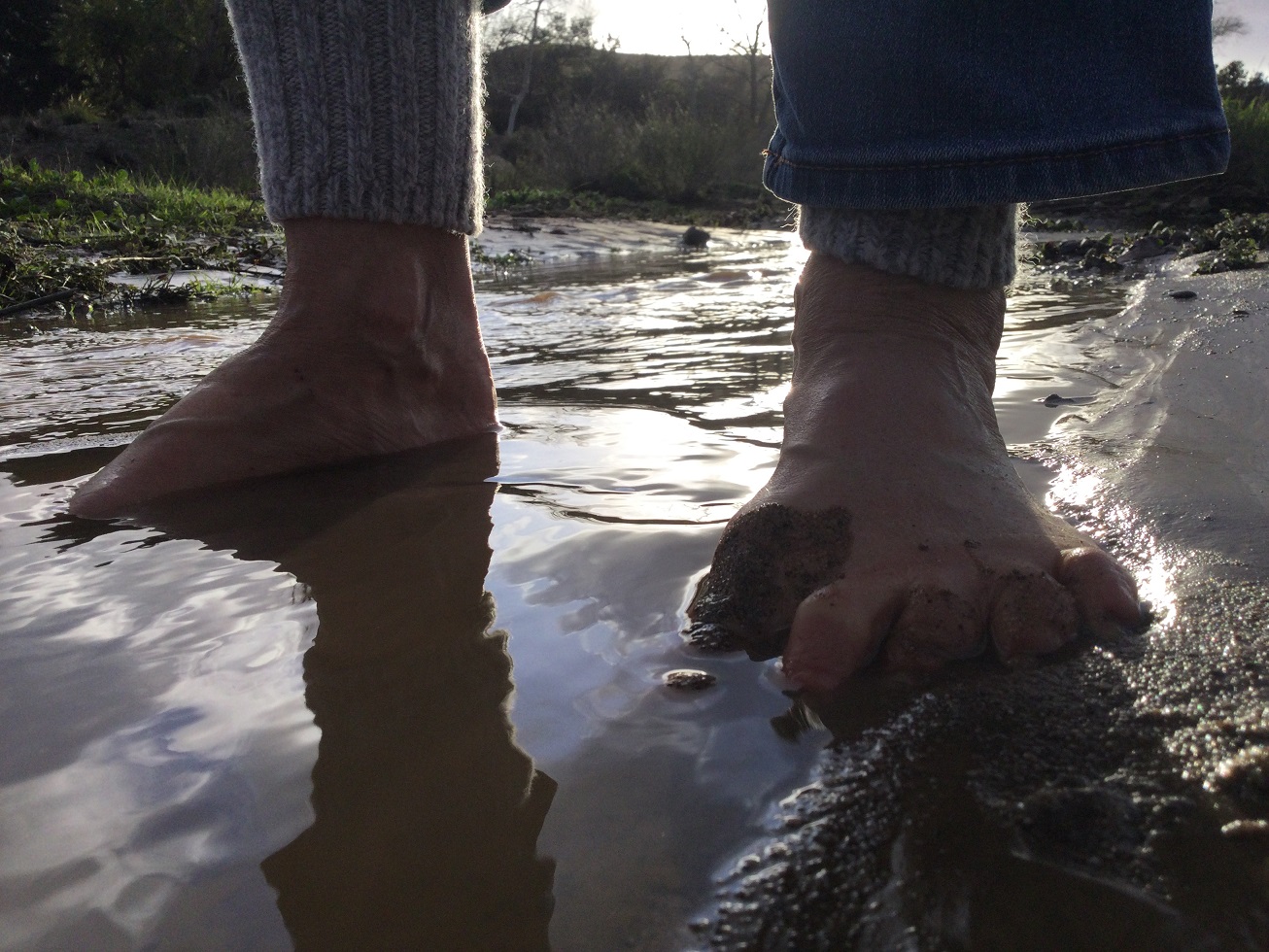
(But do realize that acclimating your feet to the cold is a process that some folks do better than others, with barefoot-shirtless-Arctic-Circle-half-marathoner Wim Hof a person worth googling.) https://www.wimhofmethod.com/
Me being from a warmish-winter part of the world, I am OK barefoot in temps down to around 50 (F). Not quite a WimHoffer, but that’s all I need to be acclimated to.
The couple of times I’ve crossed Grand Canyon barefoot in October, the early morning temps at the North Rim were in the high 30s (F) and my feet quickly turned numb.

You know the saying, “numb is dumb”? (Well, ya should!)
So . . . I started out at 6:39 a.m. with some self-stick chemical footwarmers* attached to the top of my feet (see above photo) and stopped every few minutes to rub some life into my toes, but I mainly concentrated on getting down the trail to a lower, warmer, elevation as quickly as possible.
*Note to self: these did not work very well. And they looked like feminine hygiene products.
Four hours later (10:24 am) it was time GET MY FEET WET at one of the several places where the North Kaibab trail crosses tiny side creeks. Such a fabulous feeling!

Good times! I’ll do it again, one of these days, Lord willing and the creek don’t rise . . . (but if it does rise, maybe I’ll dip my toes . . . )

Happy Barefoot Winter (possible wet?) Trails!
Tarantula Meets My Bare Feet
How’s that for a click-bait-able title?
We’ll get to the spider encounter soon enough . . . but first: It’s cross country season!
Here’s my youngest son running the Mt. SAC Invitational back in the late 1990s:

And here’s my oldest son’s daughters running at Mt. SAC last weekend:

So that makes three generations of runners!
It’s not even Thanksgiving, but there’s so much to be grateful for . . . including many recent miles for me (no more broken ankle issues! yippee!) enjoying the beauty and blessings of local trails:

The lovely shrub above is the fluffiest bloomin’ coyote bush I’ve ever seen.
The fulgent fruit below = elderberries! (#bringfulgentback)


Always inspiring: a misty morning path through resilient native plants recovering after two, too-close-in-time, fires.

Dust creates its own opportunities–but–I’m ready for rain.

Darkling beetles (stink bugs) above and below . . . these insects are key ecosystem recyclers (they eat poop), but I’ve never seen one on a flower, which makes me realize: You can hike in the “same place” every week for thirty years, and SOMETHING will always be new!

AND . . . here we go: paparazzi me goin’ for the critter + barefoot selfies:

THEN I came across this furry beauty! Of course I had to take some equally fuzzy photos.


Who knew my strong high arch could be the perfect shelter for a paparazzi-pestered arachnid?

Afterward, I felt guilty for imposing my photo-hungry agenda on the unsuspecting spider.
So I wrote a poem.
First poem in a while.
(About my first spider-slides-underfoot experience ever.)
Tarantula
 Santiago Oaks, October 2022

 In the middle of trail, it has paused—
 a familiar fuzzy shadow—so I pose
 with it for foot selfies, oblivio
 my new friend might not want to be videoed.

 As the cyclops camera glares and the spider wonders
 where to hide—I record it crawling under
 the high arch of my bare right foot, an ideal
 mini cave with welcoming warm walls.

 Our ticklish situation makes me sad—
 to film a stupid video, I have disturbed
 a fellow creature. And now it’s gettin’ snuggly
 with my bare foot. An ugly move on my

 part uncaves the poor thing. But it stays
 stuck to the ground, vulnerable. My shame
 flames up my face; I look around and run
 for the shelter of the willow thicket. Some

 times a story has no heroes in it.
 Tonight, Tarantula, how will you spin it?
Happy grateful-for-grandkids-running-crosscountry-and-I’m-back-from-a-broken-ankle-and-barefoot-strong trails . . .

Kenneth Posner, age 59, lives in New York’s Hudson Valley, where he has been hiking barefoot since 2015; his many remarkable barefoot achievements include summiting the 35 Catskill High Peaks, the 46 Adirondack High Peaks, and 36 of the 48 4,000-footers of New Hampshire, as well completing the Catskills AllTrails Challenge, which entails covering every single hiking trail in the Catskills Park (total of 350 miles).
This is a person who enjoys a good challenge!
And even though it took three tries in the last three years, Ken finally achieved his goal of shoelessly backpacking California’s 210-mile John Muir Trail (JMT) through the High Sierra this summer.

Here’s some of Ken’s hard-won insights: (all photos by Ken as well)
Q: What were some of the most challenging aspects of the John Muir Trail 210-mile through-hike?
KP: Logistics for the John Muir Trail are complex.
First you have to secure permits, which are in high demand. For each of my JMT adventures, I had to enter the trail in the middle and complete the north and south sections separately, since I couldn’t obtain straight-thru permits. Second, you need to develop a route plan indicating how many days it will take to complete the trail, because this will in turn drive your requirements for nutrition as well as travel logistics. And finally, you need to have a good backpacking kit, where you make careful trade-offs between weight and essentials.
The trail conditions vary. In the north there are miles of soft sandy trails and trails of packed dirt. These are ideal for barefooting, and on these surfaces I’ve been able to cover 12, 15, almost 20 miles in a day. In the south, however, the mountain passes are steeper and taller, and the canyons deeper, and the trails are full of rocks and gravel. Sometimes I could get no further than 6 miles in a day.
Editor notes: Ken made a ten short videos during his JMT through-hike; this one is a little lesson on dealing with the rough trail: “Walking on Cobbles” . . .
Ken titled this short video “hellacious descent from Senger Creek” because of all the (you guessed it) rocks. Takeaway quote for all barefoot hiking (and life?): “the goal is the experience.”
This next video is called “Tired of Rocks” . . . watch it and you’ll see why Ken called this area “a purgatory of rocks.”
Back to KP: While rocks are difficult, the greatest physical/mental tests for me all have to do with sticking to the route plan, because I had a limited amount of time to complete the trail (I used up most of my vacation days!), and a limited amount of food. (Editor’s note: hiking the JMT requires self-sufficiency: you must carry all your gear and food on your back.)
The worst days were when I’d budgeted what seemed like reasonable mileage, but was surprised—either because I’d forgotten how hard the terrain was, or because maybe I wasn’t having a great day for other reasons—and found myself falling behind. At one point, I was 10 miles behind plan, which was enough to jeopardize my ability to finish the trail. Fortunately, I was able to catch back up, but it took a sustained effort.

Q: Can you describe your barefoot ascent of Mt. Whitney (elevation ~ 14,500 ft / 4421m)?
KP: The barefoot ascent of Mt. Whitney is going to surely rank as one of the most surreal experiences of my life. I started at midnight in order to reach the summit by dawn. At first the trail was steeper and rockier than I expected, and the path was wet with ice-cold running water which stung my feet. Thanks to these conditions and a cup of instant coffee before heading out, I found myself getting out of breath and becoming extremely anxious. I had to say to myself, “please stop.” Gradually I got my breathing under control and proceeded more steadily.
As I moved along, the next section of the trail consisted of a series of six long switchbacks leading to a trail junction at 13,600 feet. Here the path was mostly sandy, and I made steady progress, although the trail was quite steep. I kept count of the switchbacks to pace myself. I would have used the altitude and mileage reading on my watch, but it quickly ran out of charge and stopped working. I could see headlamps of other hikers ahead of me and behind me, but otherwise the night was pitch black. It was like walking through a void.
From the trail junction, the trail passes alongside the crest of the ridge, and here the trail deteriorated into a jumble of rocks and raw granite slag, and in some places it was clear that big rocks had tumbled down, blocking part of the trail and forcing you to clamber over them. It was, in places, more like climbing on a jungle gym—not that you’d need ropes or mountaineering skills, it’s just you had to step and climb over piles of rocks—and when barefoot you can obviously not afford to slip or stumble—not to mention to the sides there were steep drop-offs of 30, 40, 50 feet or more (that’s as far as my headlamp’s beam played out). At one point there are some gaps in the crest, and you can see the lights of Lone Pine, 10,000 feet below and 20 miles away. In between some rocks, Sky Pilot (Polemenium eximium) showed its beautiful little flowers with clusters of blue petals.
Eventually I got through this stuff, and the final climb to the summit was on a sandy trail (easier on the feet)—ahead of me I could see the sky beginning to lighten. A small group of us perched on the summit and waited quietly for the sun to appear.
And then I put on shoes and descended the 6,000 feet (in 10.7 miles) to Whitney Portal, which took all day.

Q: Do you have any training tips for someone eager to duplicate your John Muir Trail (JMT) feat? (Ouch. It’s difficult to write about barefoot hiking without at least one pun.)
KP: The mountain passes are steep and tall, and people should be prepared to climb up to 3,000 feet in a day and descend that much as well. For climbing, I did a lot of stairmaster sessions, which I think were helpful. For descending—which I find often to be much more difficult while barefoot since you have to lower yourself down each step or rock quite carefully—I do single leg step-downs from a raised block.
I would advise doing plenty of practice hikes with a full pack. And finally, I made a point to take a lot of walking breaks during my work days; the rough paved road outside our house, which is scattered with gravel in places, was a great place to gradually adapt the feet to rough conditions and to get used to moving fluidly.
Q: Looking back at your three adventures on the JMT, is there anything you would do differently on a fourth attempt?
KP: Ideally more time. Completing the JMT in 22 days was a wild experience, with a mix of easy days and some that were frankly quite difficult. But “miles” don’t mean much when conditions are variable. I found that after climbing through rocks and/or walking on hot sand and gravel, my feet could only take so much friction before walking became very painful—and sometimes I had to take a break for a few hours, or just let my feet recover overnight, and start again the next day. If I had enough vacation time to do the JMT in 30 days, it would be a dream.

Q: What were some of the best (or worst) footwear-related comments people had for you on your JMT adventure?
KP: Many shod hikers reacted very positively. My favorite comments were “Respect!” and “Next level!” I met a couple of people who run barefoot but never thought about backpacking that way. One fellow from Japan asked if this was my “meditation practice,” which made me smile.
Some people asked if I was OK—which was a fair question on those gravelly sections where I was moving quite slowly and sometimes struggling. A couple of people offered to give me their camp sandals or crocs, which was nice, but I would tell them the sizes (or in some cases the colors) didn’t suit me. One person said he was going to call 911, which I did not appreciate.
What got tiresome was “Where are your shoes?” and “Who stole your shoes?” I told these people that a bear cub had taken my shoes, which I think they believed.
Q: How does through-hiking the JMT compare to your thousands of miles of New York/New England trail adventures?
KP: The JMT trails are generally not as steep, since they’re graded for stock. And they’re beautifully constructed with thousands of stone steps and retaining walls, whereas New England trails are comparatively rough, crude, and often washed-out.
However, a lot of the JMT is above treeline, which means you’re exposed to the sun—and on those trails with a southern aspect, which get the full brunt of the noonday sun, the sand can turn quite hot, which is not going to happen in New England.
Q: What’s the next barefoot adventure you are planning?
I’d like to finish the 48 New Hampshire 4,000-footers (12 to go) and maybe bag Maine and Vermont’s high peaks, too. But otherwise, I don’t know.
I think there is something special out there waiting for me, but I do not yet know what it is.

Q: Thanks for your insight, Ken! I’m inspired and hope others are too. (You can follow Ken’s barefoot adventures on his blog, “The Long Brown Path.“)
Happy (rocky) trails!
Learning my way back from an ankle fracture
Five years ago this month I retired from teaching creative writing at a local university to help with this guy . . .


. . . and to check a few items off my bucket list. (A worldwide pandemic was NOT one of those items, but I got it out of the way anyway.)
Here’s something I’ve always wanted to try:
Horse jumping! So much fun! So much to learn!

Coming off a horse due to rider error! Not so much fun! So much to learn!

As soon as I hit the ground–with all the impact absorbed by my suddenly akimbo left foot– I knew things were not good. My active life had changed in a second.

The X-ray didn’t show it, but the CT scan did: a non-displaced fracture of the talus bone in my left ankle.
Sigh.

Several visits to an orthopedic surgeon resulted in . . . not much more than the recommendation I should avoid any weight bearing on the foot for six weeks, and probably give up barefoot running forever.
(My take on the situation? If I hadn’t been running barefoot for the last twelve years, my ankle would not have been strong enough to weather the fall with only a cracked talus instead of each-and-every ankle bone exploding in a million osteoporisized bits.)
Fortunately I already had an excellent team of movement experts (I think orthopedic surgeons specialize in non-movement?) who provided more appropriate therapy (and advice) so that I could continue to heal as quickly as possible, with as little residual stiffness as possible. Thanks, Darcia and Dr. Derrick!

So much to learn–such as how to negotiate life in a boot whilst not putting any weight on booted foot.
It didn’t stop me from crutching it to the sidelines for soccer spectating. (Two granddaughters play for a high school about 80 miles south. I learned to be very grateful that my booted left foot did not interfere with driving.)
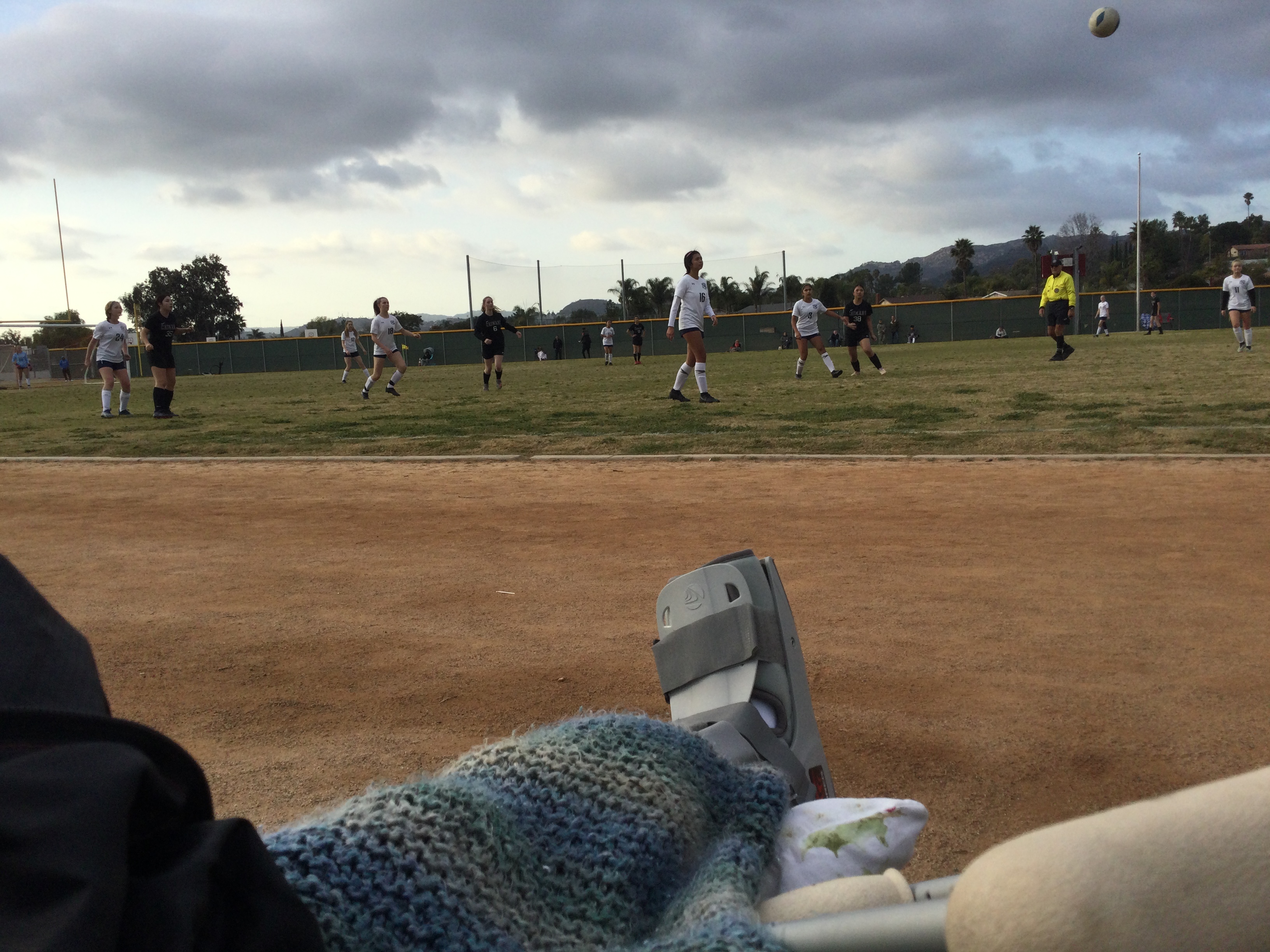
AND . . . here’s a major learning breakthrough . . . I learned I would go cuckoo if I didn’t find some kind of movement activity. Right away.
I found one at my local community college which was just beginning its Spring semester.
It’s called Swimming, an activity that–when I was a kid–made me feel like I was drowning when I tried to do “the crawl” all the way across the width of the pool on the last day of any given two-week summer swim lesson session at the Orange Plunge.
I learned via a little online research that there is an easier way to get across a pool: the Total Immersion way of swimming. This method actually makes swimming relaxing, makes it a zen-ish gliding through the water (based on the power of hip rotation instead of frantically thrashing arms and legs).
A logical (?!) next immediate step: sign up for a triathlon later this year, because: Swimming! It’s learnable, do-able, and *almost* as fun as running barefoot.
But the triathlon is not in a pool . . . it’s in the cold waters off California’s Central Coast, which is conveniently where my daughter and her family live.
So . . . there we went last weekend for my inaugural salt water (cold water!) swim. That’s Morro Rock in the background, and in the kayak: my significant-athletic-endeavor-supporter (46 years and counting).
And, of course, me in my lovely new Orca swimming wetsuit hamming it up for the camera. (Photo by the inimitable Tina Davidson.)
In early November I’ll join a couple hundred other triathletes here to swim, bike, and run our way around Morro Bay. Can’t wait!

Hmmm . . . it might be good if I got back to running by then . . . so that’s also what I’m working on, one slow step at a time.

And some muddy steps-at-a-time. (Never pass a mud bog when you can toe-wallow in it.)

And never pass a wildflower without saying “hello.

Other pastimes to while away the hours that I am not yet running: sourdough baking (and devouring).

Spectating at granddaughters’ track meets.

Dragging my early 1970s Nike spikes out of the attic. And sighing. Coulda woulda shoulda.

Consuming pounds of Pound Plus to assuage my non-track-career nostalgia and all-around sense of crapitude because I haven’t been able to run. Since. January.

Staring out the window at all the wonderful California native plants and (non-native, but delicious) citrus trees in my garden.

Having fun with grandsons and grand-dog.

Renewing my NOLS Wilderness First Responder certification in hopes I will one day lead more wilderness adventures. (It was not easy spending three days of responding to wilderness injury-and-illness scenarios in a giant immobilizing boot. I’m glad that’s over. These CPR babies are too.)

Propagating California native plants in my garden.

Admiring California native plants from my car at Irvine Park.

Finally, RUNNING just a little. Then a little more. Then maybe a fast 5k by the time the triathlon rolls around in November?

And, of course, glorious swimming two mornings a week at 7 am at the community college pool. It’s an actual college class with homework, and quizzes, and papers to write, and timed 500-yard swims. My time yesterday: a blistering (or meandering?) 12:40 for 20 laps across the 25-yard width of the pool . . . never once feeling like I was flailing, floundering, or drowning.
Yay for old-lady learning and a healing ankle. Yay, and praise the Lord!

Happy barefoot trails . . . on land or in water!
Twelve Years of Barefoot Running (and still going at age 62)

Every January I like to toast with a post here, since this is the month (back in 2010, TWELVE years ago!) when the idea of being shoeless on the trails first struck me.
In the early morning chill at O’Neill Park, standing at a birding-workshop campfire, I noticed a couple of shoeless young men on the other side of the flames. In my typical sad snarky fashion, I poked the arm of the person next to me and snickered some snide side remark about their lack of outdoor intelligence.
Later that day, though, I couldn’t stop wondering about what I had seen.
So . . . in my less-judgy, hungry-for-knowledge fashion, I deep dove online and discovered: barefoot running was a Thing (although I didn’t read Born to Run until a year later, Barefoot Ken Bob’s book was helpful in the early going).

A few (330?!) blog posts later, I am still trotting along: looking, listening, FEELING (loving!) the dirt world of our local Orange County foothills (and, every so often, beyond).

While I began my barefoot journey hoping for an instant, magic cure for a lifetime of running aches, pains, and outright injuries, I have learned that moving in a healthy way is a life-long path.
A multitude of therapies and therapists later (let’s see which ones I remember: orthopedic surgeon/rooster comb injections; several kinds of physical therapy; acupuncture; Rolfing; Pilates; chiropractic; ART (Active Release Techniques); Matrix Repatterning), I’ve found a good fit with the “gentle, mindful movements” of the Feldenkrais Method of Somatic Education. (And also the healing touch of the wonderful folks at Knight Physical Therapy.)
When I consider how sad my running life had become due to constant left knee pain–my pathetic goal was to jog two whole minutes at a time back in the early 2000s–I can’t stop grinning (who cares about a few bugs in the teeth) on the regular 90-120-minute trail running adventures I enjoy several times a week.

Here’s something I wrote as a guest blog back in 2014 (wow . . . that’s eight years ago already!); I still stand by these (over-the-top?) enthusiastic musings at Barefoot Beginner: “The joys of barefoot trail running.”
Although I’ve never been one much for running races (it’s complicated, but another one of my less-better angels is my competitive nature), last year I tried a few: the Anaheim Hills 10k on July 4, the Tustin School District Dino Dash 5k on Halloween, and an 18-mile trail race on Dec. 4 (in one of my favorite places, put on by my favorite local race directors at Into The Wild OC Trail Runs).

Since I had finished second in my age group in the 10k and 5k, I had delusions of the same sort of “success” in the December race.
Sure, it was three times as long as the 10k.
Sure, it “only” had 4,035 feet of elevation gain/loss (for comparison, going rim to rim at Grand Canyon is around 10,000 feet of down-then-up).
Sure, the race blurb said “course is recommended for an experienced runner.”
Sure, it turned out to be another lesson in humility.
Or reality?
I’m 62, and more inclined to over-dose on dark chocolate than over-train . . . so I might have been a bit less than ready for the relentless hills of the 17.9-mile popsicle/loop from Irvine Park and up and around Fremont Canyon.

The uphills taxed my aerobic engine when I attempted anything more than a walk, and the downhills–which I had been looking forward to as a time when gravity would be on my side–turned tortuous again after about mile eleven.

My left knee! On fire again! What in thunderation was going on with my old owie?
Sure, it didn’t hurt to walk down the hills, but at that rate I’d still be out there, so I repeated the awkwardly rhymed affirmation “there’s nothing wrong with my knee, and there’s a lot right with me” and did my best not to limp and throw off the rest of my geezer body.
62 years young.
My “race goal” morphed from “win my age group and take home a cool prize” to “don’t finish last” to “let’s just finish some time today.”

While the results show I accomplished two of those three goals (112th out of 18, time of 4:42:06), when I closely examined the race results I realized I had been in the presence of greatness: I finished 10th out of 10 heroic women in the 60-69 age group.

How much faster were they? First place–Karen Greene, 60–was done almost an hour before me (with a 12:29 minutes/mile pace in contrast to my 16:07/mile).
My new heroes! Too bad they were packed and gone by the time I (finally) finished . . .
And: yet another lesson in humility adaptability: I had to wear shoes the entire race because of our lovely local ROCKY geology.
And so, for the first time in over a decade, I now sport a black toenail on my left big toe. (Did I mention the race went downhill. A lot.)
On the plus side: I was able to embody the long-distance-runner’s mantra I had read about in so many race reports over the years: “relentless forward progress.” That’s quite a mouthful to repeat–especially when your mouth is full of yummy dried figs and Trader Joe’s dark chocolate–but It Works.

In the middle of a long race, or long project (hmmm . . . the book I’m working on?), the temptation to stop & give in/give up is strong. Especially when old pains return, and everyone else makes it look so easy, and it seems like you’re the only one struggling . . .
But Comparison Lane leads to dark places, so let’s not go there.

A 28,000-acre wildfire swept through these hills and canyons back in October 2007; so much was lost.
After the burn, however, enough winter rain fell to ignite this blaze of poppies above Fremont Canyon the next spring (the same area that I ran in last month):

I was fortunate to be able to spend a day in the company of plein air artist Jim Wodark as he interpreted the scene in a painting he titled “After the Burn.”


And now that painting hangs near my front door.
The Fremont Canyon area holds many memories in its lovely folds; last month’s race added another set.

It was difficult to keep plodding for hours at my slow pace, ghost pains stabbing my knee with every downhill, toenail-bruising footfall, but I hope the experience of embodying “relentless forward progress” will stick with me in this not-so-new year. (Is it just me, or does 2022 seem an awful lot like 2020-too?)
The fog will lift!

Happy New Year & Happy Barefoot Trails!

 Barefoot Wandering and Writing